In What Ways Does Islamic Art Appropriate Graecoroman Forms Quizlet
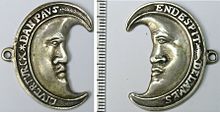
Christianity and Islam are the two largest religions in the world, with two.vi billion and ane.9 billion adherents, respectively.[one] Both religions are considered as Abrahamic, and are monotheistic, originating in the Middle Due east.
Christianity adult out of Second Temple Judaism in the 1st century CE. It is founded on the life, teachings, death, and resurrection of Jesus Christ, and those who follow it are called Christians.[2] Islam developed in the 7th century CE. Islam, founded on the teachings of Muhammad as an expression of give up to the will of God. Those who follow it are called Muslims which means "submitter to God".[3] [4]
Muslims view Christians to be People of the Book, and also regard them as kafirs (unbelievers) committing shirk (polytheism) considering of the Trinity, and thus, contend that they must be dhimmis (religious taxpayers) nether Sharia law. Christians similarly possess a wide range of views about Islam. The majority of Christians view Islam as a imitation organized religion due to the fact that its adherents reject the Trinity, the divinity of Christ, and the Crucifixion and Resurrection of Christ.
Islam considers Jesus to be the al-Masih (Arabic for Messiah) who was sent to guide the Banī Isrā'īl (Arabic for Children of State of israel) with a new revelation: al-Injīl (Arabic for "the Gospel").[5] [6] [7] Christianity also believes Jesus to be the Messiah prophesied in the Hebrew scriptures. However, far more cardinal to the Christian religion is that Jesus is the incarnated God, specifically, ane of the hypostases of the Triune God, God the Son. Belief in Jesus is a central function of both Christian and Islamic theology.
Christianity and Islam have different sacred scriptures. The sacred text of Christianity is the Bible while the sacred text of Islam is the Quran. Muslims believe that al-Injīl was distorted or altered to form the Christian New Testament. Christians, on the contrary, do not have a univocal understanding of the Quran, though most believe that it is fabricated or counterfeit piece of work. At that place are similarities in both texts, such equally accounts of the life and works of Jesus and the virgin birth of Jesus through Mary; yet even so, some Biblical and Quranic accounts of these events differ.
Similarities and differences
The discussion about whether Muslims and Christians worship the same God brings out a whole nest of philosophical confusions. The argument that "Yahweh" and "Allah" are referring to the same entity, despite the different concepts of God involved, is not sound.[ commendation needed ] A greater problem is that "worships ten" is what analytic philosophers, similar Peter van Inwage, a leading professor in the philosophy of organized religion, characterization an "intensional (as opposed to extensional) context", where the term "x" does not have to refer to anything at all (as in, e.g., "Jason worships Zeus"). In an "intensional context" co-referring terms cannot be replaced without affecting the truth value of the statement. For case, even though "Jupiter" may refer to the same entity every bit "Zeus", withal Jason, a Greek, does not worship Jupiter and may not even be aware of the Roman deity. So information technology cannot be said that "Abdul," a Muslim, worships Yahweh, even if Yahweh and Allah are co-referring names.[8] [9]
Scriptures
The Christian Bible is made up of the Former Attestation and the New Testament. The Old Testament was written over a menstruum of two millennia prior to the nativity of Christ. The New Testament was written in the decades following the death of Christ. Historically, Christians universally believed that the unabridged Bible was the divinely inspired Give-and-take of God. However, the rise of higher criticism during the Enlightenment has led to a diversity of views concerning the authorisation and inerrancy of the Bible in dissimilar denominations. Christians consider the Quran to be a non-divine prepare of texts.
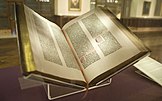
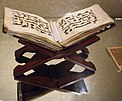
The Bible (left) and the Quran (correct)
The Quran dates from the early seventh century, or decades thereafter. Muslims believe it was revealed to Muhammad, gradually over a period of approximately 23 years, beginning on 22 Dec 609,[10] when Muhammad was twoscore, and concluding in 632, the year of his expiry.[11] [12] [thirteen] The Quran assumes familiarity with major narratives recounted in the Jewish and Christian scriptures. It summarizes some, dwells at length on others and differs in others.[14] [xv] [16] Muslims believe that Jesus was given the Injil (Greek evangel, or Gospel) by Allah and that parts of these teachings were lost or distorted (tahrif) to produce the Hebrew Bible and the Christian New Testament. The majority of Muslims consider the Quran to be the simply revealed volume that has been protected by God from distortion or corruption,[17] being remained unchanged and unedited since the death of Muhammad, though scholars and early on Islamic sources reject this traditionalist view.[18]
Jesus
Muslims and Christians both believe that Jesus was born to Mary, a virgin.[19] They both as well believe that Jesus is the Messiah.[19] Yet, they differ on other key issues regarding Jesus. Christians believe that Jesus was the incarnated Son of God, divine, and sinless. Islam teaches that Jesus was one of the most important prophets of God, just not the Son of God, not divine, and not office of the Trinity. Rather, Muslims believe the creation of Jesus was similar to the creation of Adam (Adem).
Christianity and Islam likewise differ in their key views related to the crucifixion and resurrection of Jesus. Christianity teaches that Jesus was condemned to death by the Sanhedrin and the Roman prefect Pontius Pilate, crucified, and later three days, resurrected. Islam teaches that Jesus was a man prophet who, similar the other prophets, tried to bring his people to worship God, termed Tawhid. Muslims likewise believe that Jesus was condemned to crucifixion and then miraculously saved from execution, and was raised to the heavens.[20] In Islam, instead of Jesus being crucified, his lookalike was crucified.[21]
Both Christians and Muslims believe in the Second Coming of Jesus. Christianity does not state where will Jesus return, while the Hadith in Islam states that Jesus will return at a white minaret at the eastward of Damascus (believed to be the Minaret of Isa in the Umayyad Mosque), and will pray behind Mahdi.[22] Christians believe that Jesus will return to kill the Antichrist and similarly Muslims believe that Jesus volition return to kill Dajjal. Many Christians believe that Jesus would and so rule for 1,000 years, while Muslims believe Jesus will rule for forty years, marry, have children and volition exist cached at the Green Dome.[22]
Muhammad
Muslims believe that Muhammad was a prophet, who received revelations (Quran) by God through the affections Gabriel (Jibril),[23] [24] gradually over a period of approximately 23 years, beginning on 22 December 609,[25] when Muhammad was 40, and concluding in 632, the year of his decease.[26] [12] [13] Muslims regard the Quran as the most important miracle of Muhammad, a proof of his prophethood,[27] and the culmination of a series of divine messages that started with the messages revealed to Adam and ended with Muhammad. Muslims also believe that the reference to the Paraclete in the Bible is a prophecy of the coming of Muhammad.[28] [29]
Muslims revere Muhammad as the embodiment of the perfect believer and have his actions and sayings equally a model of ideal deport. Unlike Jesus, who Christians believe was God's son, Muhammad was a mortal, albeit with extraordinary qualities. Today many Muslims believe that it is wrong to represent Muhammad, but this was non always the example. At various times and places pious Muslims represented Muhammad although they never worshiped these images.[xxx]
During the lifetime of Muhammad, he had many interactions with Christians. I of the start Christians who met Muhammad was Waraqah ibn Nawfal, a Christian priest of ancient Arabia. He was one of the first hanifs to believe in the prophecy of Muhammad.[31] Muhammad besides met the Najrani Christians and made peace with them.[32] [33] I of the earliest recorded annotate of a Christian reaction to Muhammad can be dated to simply a few years later on Muhammad's expiry. As stories of the Arab prophet spread to Christian Syrian arab republic, an old man who was asked nearly the "prophet who has appeared with the Saracens" responded: "He is false, for the prophets do not come armed with a sword."[34]
God
In Christianity, the most common proper noun of God is Yahweh. In Islam, the most mutual proper name of God is Allah, similar to Eloah in the Erstwhile Attestation. The vast bulk of the world's Christians attach to the doctrine of the Trinity, which in creedal formulations states that God is 3 hypostases (the Begetter, the Son and the Spirit) in 1 ousia (substance). In Islam, this concept is deemed to exist a denial of monotheism, and thus a sin of shirk,[35] which is considered to be a major 'al-Kaba'ir' sin.[36] [37] The Quran itself refers to Trinity in Al-Ma'ida five:73 which says "They accept certainly disbelieved who say, "Allah is the third of iii." And at that place is no god except i God. And if they exercise not desist from what they are saying, there volition surely agonize the disbelievers among them a painful punishment."[38] Islam has the concept of Tawhid which is the concept of a single, indivisible God, who has no partners.[39]
The Holy Spirit
Christians and Muslims have differing views almost the Holy Spirit. Near Christians believe that the Holy Spirit is God, and the tertiary member of the Trinity. In Islam, the Holy Spirit is generally believed to be the affections Gabriel.[ citation needed ] Nearly Christians believe that the Paraclete referred to in the Gospel of John, who was manifested on the 24-hour interval of Pentecost, is the Holy Spirit.[40] [41] Most Muslims believe that the reference to the Paraclete is a prophecy of the coming of Muhammad.[42]
I of the key verses concerning the Paraclete is John 16:vii:
"Even so I tell you the truth: It is expedient for you lot that I get away; for if I go not away, the Comforter volition non come up unto y'all; but if I get, I volition send him unto you."
Salvation
The Catechism of the Cosmic Church building, the official doctrine document released by the Roman Catholic Church, has this to say regarding Muslims:
The Church'south relationship with the Muslims. "The plan of salvation as well includes those who acknowledge the Creator, in the first place amongst whom are the Muslims; these profess to hold the religion of Abraham, and together with usa they adore the one, merciful God, flesh'due south judge on the last solar day."
— Catechism of the Catholic Church [43]
Protestant theology more often than not emphasizes the necessity of faith in Jesus every bit a savior in order for salvation. Muslims may receive conservancy in theologies relating to Universal reconciliation, but will not according to virtually Protestant theologies based on justification through religion:
"The first and chief commodity is this: Jesus Christ, our God and Lord, died for our sins and was raised again for our justification (Romans 3:24-25). He alone is the Lamb of God who takes away the sins of the world (John 1:29), and God has laid on Him the iniquity of united states all (Isaiah 53:6). All have sinned and are justified freely, without their own works and claim, past His grace, through the redemption that is in Christ Jesus, in His blood (Romans 3:23-25). This is necessary to believe. This cannot be otherwise caused or grasped by any work, law or merit. Therefore, it is clear and certain that this organized religion alone justifies united states of america ... Cipher of this article tin be yielded or surrendered, even though heaven and globe and everything else falls (Mark 13:31)."
The Quran explicitly promises conservancy for all those righteous Christians who were there before the inflow of Muhammad:
Lo! Those who believe (in that which is revealed unto thee, Muhammad), and those who are Jews, and Christians, and Sabians – whoever believeth in Allah and the Last Day and doeth right – surely their reward is with their Lord, and in that location shall no fear come upon them neither shall they grieve.
The Quran likewise makes it clear that the Christians will exist nearest in love to those who follow the Quran and praises Christians for beingness humble and wise:
And thou wilt find the nearest of them in amore to those who believe (to be) those who say: Lo! We are Christians. That is considering there are among them priests and monks and because they are not proud. When they mind to that which hath been revealed unto the messengers, thou seest their eyes overflow with tears considering of their recognition of the Truth. They say: Our Lord, we believe. Inscribe us as among the witnesses.
How should we not believe in Allah and that which hath come unto us of the Truth. And (how should we not) hope that our Lord will bring us in forth with righteous folk?
Allah hath rewarded them for that their saying – Gardens underneath which rivers flow, wherein they will abide forever. That is the reward of the good.
Early and Medieval Christian writers on Islam and Muhammad

Dante, a Christian, and Virgil looking at Muhammad who suffers in hell equally a schismatic, an illustration of the Divine Comedy by Gustave Doré. During the Middle Ages, Islam was often seen as a Christological heresy and Muhammad equally a false prophet.
John of Damascus
In 746 John of Damascus (sometimes St. John of Damascus) wrote the Fount of Knowledge role two of which is entitled Heresies in Epitome: How They Began and Whence They Drew Their Origin.[47] In this work St. John makes all-encompassing reference to the Quran and, in St. Johns's opinion, its failure to live up to fifty-fifty the most basic scrutiny. The work is non exclusively concerned with the Ismaelites (a name for the Muslims every bit they claimed to have descended from Ismael) but all heresy. The Fount of Noesis references several suras directly often with apparent incredulity.
From that time to the present a imitation prophet named Mohammed has appeared in their midst. This man, after having chanced upon the Old and New Testaments and as well, it seems, having conversed with an Arian monk, devised his ain heresy. And then, having insinuated himself into the good graces of the people by a show of seeming piety, he gave out that a sure book had been sent downward to him from heaven. He had ready downwardly some ridiculous compositions in this volume of his and he gave information technology to them as an object of veneration. ... There are many other extraordinary and quite ridiculous things in this book which he boasts was sent down to him from God. But when we enquire: 'And who is there to testify that God gave him the book? And which of the prophets foretold that such a prophet would rise upwards?' – they are at a loss. And nosotros remark that Moses received the Law on Mount Sinai, with God actualization in the sight of all the people in deject, and fire, and darkness, and tempest. And nosotros say that all the Prophets from Moses on downwards foretold the coming of Christ and how Christ God (and incarnate Son of God) was to come up and to be crucified and die and rise once again, and how He was to be the judge of the living and dead. Then, when nosotros say: 'How is it that this prophet of yours did not come in the aforementioned way, with others bearing witness to him? And how is it that God did not in your presence nowadays this human with the book to which you refer, even as He gave the Law to Moses, with the people looking on and the mountain smoking, so that you, likewise, might have certainty?' – they answer that God does as He pleases. 'This,' we say, 'We know, only we are asking how the book came downwardly to your prophet.' Then they reply that the book came down to him while he was asleep.[48]
Theophanes the Confessor
Theophanes the Confessor (died c.822) wrote a series of chronicles (284 onwards and 602-813 Advertizement)[49] [50] [51] based initially on those of the meliorate known George Syncellus. Theophanes reports well-nigh Muhammad thus:
At the showtime of his advent the misguided Jews thought he was the Messiah. ... Only when they saw him eating camel meat, they realized that he was non the i they thought him to be, ... those wretched men taught him illicit things directed against u.s., Christians, and remained with him.
Whenever he came to Palestine he consorted with Jews and Christians and sought from them certain scriptural matters. He was too afflicted with epilepsy. When his married woman became enlightened of this, she was greatly distressed, inasmuch every bit she, a noblewoman, had married a human such as he, who was not but poor, just likewise an epileptic. He tried deceitfully to placate her by saying, 'I keep seeing a vision of a certain angel called Gabriel, and being unable to bear his sight, I faint and fall down.'
Nicetas
In the work A History of Christian-Muslim Relations [52] Hugh Goddard mentions both John of Damascus and Theophanes and goes on to consider the relevance of Nicetas[ clarification needed ] of Byzantium who formulated replies to letters on behalf of Emperor Michael 3 (842-867). Goddard sums up Nicetas' view:
In short, Muhammad was an ignorant charlatan who succeeded by imposture in seducing the ignorant barbaric Arabs into accepting a gross, blaspheming, idolatrous, demoniac organized religion, which is full of futile errors, intellectual enormities, doctrinal errors and moral aberrations.
Goddard further argues that Nicetas demonstrates in his piece of work a knowledge of the entire Quran, including an extensive noesis of Suras 2-18. Nicetas account from behind the Byzantine frontier apparently gear up a stiff precedent for later on writing both in tone and points of argument.
Song of Roland
The writer(s) of the 11th century Song of Roland evidently had little actual knowledge of Islam. As depicted in this epic verse form, Muslims erect statues of Mohammed and worship them, and Mohammed is office of an "Unholy Trinity" together with the Classical Greek Apollyon and Termagant, a completely fictional deity fabricated up by Christians in the Middle Ages. This view, evidently confusing Islam with the pre-Christian Graeco-Roman Organized religion, appears to reflect misconceptions prevalent in Western Christian society at the time.
The Divine Comedy
In Dante Alighieri'due south Divine Comedy, Muhammad is in the ninth ditch of Malebolge, the eighth realm, designed for those who have caused schism; specifically, he was placed amongst the Sowers of Religious Discord. Muhammad is portrayed as split in one-half, with his entrails hanging out, representing his status every bit a heresiarch (Canto 28).
This scene is frequently shown in illustrations of the Divine Comedy. Muhammad is represented in a 15th-century fresco Final Judgment by Giovanni da Modena and cartoon on Dante, in the San Petronio Basilica in Bologna,[53] besides as in artwork by Salvador Dalí, Auguste Rodin, William Blake, and Gustave Doré.[54]
Catholic Church and Islam
Second Vatican Council and Nostra aetate
The question of Islam was non on the calendar when Nostra aetate was beginning drafted, or even at the opening of the Second Vatican Quango. However, as in the case of the question of Judaism, several events came together again to prompt a consideration of Islam. By the time of the Second Session of the Quango in 1963 reservations began to be raised by bishops of the Middle East about the inclusion of this question. The position was taken that either the question will non exist raised at all, or if it were raised, some mention of the Muslims should be made. Melkite patriarch Maximos IV was among those pushing for this latter position.
Early in 1964 Key Bea notified Central Cicognani, President of the Quango's Coordinating Commission, that the Council fathers wanted the Council to say something nearly the great monotheistic religions, and in particular well-nigh Islam. The subject, however, was deemed to exist exterior the competence of Bea's Secretariat for the Promotion of Christian Unity. Bea expressed willingness to "select some competent people and with them to describe up a draft" to exist presented to the Coordinating Commission. At a meeting of the Coordinating Commission on sixteen–17 April Cicognani acknowledged that information technology would be necessary to speak of the Muslims.[55]
The period betwixt the outset and 2d sessions saw the change of pontiff from Pope John XXIII to Pope Paul 6, who had been a member of the circle (the Badaliya) of the Islamologist Louis Massignon. Pope Paul Six chose to follow the path recommended by Maximos Iv and he therefore established commissions to introduce what would become paragraphs on the Muslims in ii different documents, 1 of them being Nostra aetate, paragraph three, the other existence Lumen gentium, paragraph 16.[56]
The text of the final typhoon bore traces of Massignon'south influence. The reference to Mary, for example, resulted from the intervention of Monsignor Descuffi, the Latin archbishop of Smyrna with whom Massignon collaborated in reviving the cult of Mary at Smyrna. The commendation of Muslim prayer may reflect the influence of the Badaliya.[56]
In Lumen gentium, the Second Vatican Council declares that the program of conservancy also includes Muslims, due to their professed monotheism.[57]
Recent Cosmic-Islamic controversies
- For the controversy surrounding Muslim prayer in Spain, run into Muslim entrada at Córdoba Cathedral
- For criticism of interfaith dialogue with Muslims, see Pierre Claverie#Relations with Islam
- For the controversy over whether Islam is a religion or a political system, see Raymond Leo Burke#Islam and clearing
- For the controversy over advice not to marry a Muslim and move to an Islamic land, meet José Policarpo#Marriages with Muslim men
- For the controversy over whether Catholics may call God "Allah" if they desire to, run across Titular Roman Catholic Archbishop of Kuala Lumpur five Menteri Dalam Negeri
- For the controversy over remarks past Pope Benedict Xvi, see Regensburg lecture and Pope Benedict Xvi and Islam
Protestantism and Islam
Protestantism and Islam entered into contact during the 16th century, at a time when Protestant movements in northern Europe coincided with the expansion of the Ottoman Empire in southern Europe. Every bit both were in conflict with the Cosmic Holy Roman Empire, numerous exchanges occurred, exploring religious similarities and the possibility of merchandise and military alliances.[58] Relations became more conflictual in the early modern and modern periods, although recent attempts take been made at rapprochement.[59]
Mormonism and Islam
Mormonism and Islam have been compared to one another ever since the earliest origins of the former in the nineteenth century, often past detractors of ane organized religion or the other—or both.[60] For case, Joseph Smith, the founding prophet of Mormonism, was referred to as "the modern Mahomet" by the New York Herald,[61] shortly later on his murder in June 1844. This epithet repeated a comparison that had been made from Smith's earliest career,[62] 1 that was not intended at the time to be gratis. Comparison of the Mormon and Muslim prophets still occurs today, sometimes for derogatory or polemical reasons[63] but also for more scholarly and neutral purposes.[64] While Mormonism and Islam certainly have many similarities, there are also significant, primal differences between the two religions. Mormon–Muslim relations have historically been cordial;[65] recent years take seen increasing dialogue between adherents of the ii faiths, and cooperation in charitable endeavors, especially in the Middle and Far Due east.[66]
Christianity and Druze
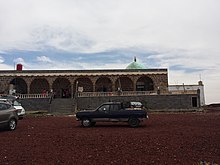
Christianity and Druze are Abrahamic religions that share a historical traditional connection with some major theological differences. The two faiths share a common place of origin in the Middle East, and consider themselves to exist monotheistic. Fifty-fifty though the faith originally developed out of Ismaili Islam, Druze practice non identify as Muslim.[67] [68]
The relationship between the Druze and Christians has been characterized past harmony and coexistence,[69] [seventy] [71] [72] with amicable relations between the two groups prevailing throughout history, with the exception of some periods, including 1860 Mount Lebanon civil war.[73] [74] Over the centuries a number of the Druze embraced Christianity,[75] [76] [77] [78] such as some of Shihab dynasty members,[79] as well as the Abi-Lamma clan.[lxxx]
Contact betwixt Christians (members of the Maronite, Eastern Orthodox, Melkite and other churches) and the Unitarian Druze led to the presence of mixed villages and towns in Mount Lebanon, Jabal al-Druze,[81] Galilee, and Mount Carmel. The Maronites and the Druze founded modern Lebanon in the early eighteenth century, through the ruling and social system known as the "Maronite-Druze dualism" in Mount Lebanese republic Mutasarrifate.[82]
Christianity does non include belief in reincarnation or the transmigration of the soul, unlike the Druze.[83] Christians appoint in evangelism, often through the institution of missions, different the Druze who practise not take converts; even matrimony outside the Druze religion is rare and strongly discouraged. Similarities between the Druze and Christians include commonalities in their view of views on union and divorce, as well every bit belief in the oneness of God and theophany.[83] The Druze organized religion incorporates some elements of Christianity,[84] [85] and other religious beliefs.
Both faiths give a prominent identify to Jesus:[86] [87] Jesus is the cardinal effigy of Christianity, and in the Druze faith, Jesus is considered an important prophet of God,[86] [87] being among the 7 prophets who appeared in different periods of history.[88] Both religions venerated John the Baptist,[89] Saint George,[ninety] Elijah,[89] and other common figures.
Artistic influences
Islamic art and culture accept both influenced and been influenced by Christian art and culture. Some arts accept received such influence strongly, especially religious architecture in the Byzantine and medieval eras[91] [92]
See also
- Ashtiname of Muhammad
- Chrislam (Yoruba), a syncretist organized religion
- Christian influences in Islam
- Christian philosophy
- Christianity and other religions
- Christianity and state of war
- Crusades
- Constantinople
- Divisions of the world in Islam
- Islam and other religions
- Islamic philosophy
- Islam and war
- Muhammad's views on Christians
References
- ^ "Faith by Land 2021". Archived from the original on 2020-07-30.
- ^ "Christianity".
- ^ Gardet, L.; J. Jomier (2012). "Islām". In P. Bearman; Thursday. Bianquis; C.East. Bosworth; E. van Donzel; Due west.P. Heinrichs (eds.). Encyclopaedia of Islam (2nd ed.). Brill. doi:x.1163/1573-3912_islam_COM_038 (inactive 28 February 2022).
{{cite encyclopedia}}: CS1 maint: DOI inactive as of February 2022 (link) (subscription required) - ^ Bravmann, K. K. (1977), Studies in Semitic Philology, BRILL, p. 441, ISBNxc-04-04743-3
- ^ Glassé, Cyril (2001). The new encyclopedia of Islam, with introduction past Huston Smith (Édition révisée. ed.). Walnut Creek, CA: AltaMira Printing. p. 239. ISBN9780759101906.
- ^ McDowell, Jim, Josh; Walker, Jim (2002). Understanding Islam and Christianity: Behavior That Separate Us and How to Talk Almost Them. Euguen, Oregon: Harvest House Publishers. p. 12. ISBN9780736949910.
- ^ The Oxford Dictionary of Islam, p.158
- ^ Inwagen, Peter van (Jan 2015). "Did God Create Shapes?". Philosophia Christi. 17 (2): 285–290. doi:10.5840/pc201517224. Retrieved fourteen March 2021.
- ^ Craig, William Lane (2015). "Response to Bridges and Van Inwagen". Philosophia Christi. 17 (2): 291–297. doi:ten.5840/pc201517225. Retrieved 14 March 2021.
- ^ * Chronology of Prophetic Events, Fazlur Rehman Shaikh (2001) p. 50 Ta-Ha Publishers Ltd.
- Quran 17:105
- ^ Nasr, Seyyed Hossein (2007). "Qurʾān". Encyclopædia Britannica Online . Retrieved 24 September 2013.
- ^ a b Living Religions: An Encyclopaedia of the Earth's Faiths, Mary Pat Fisher, 1997, page 338, I.B. Tauris Publishers.
- ^ a b Quran 17:106
- ^ proper noun=sanigosian
- ^ Nigosian, Due south.A (2004). Islam : its history, teaching and practices ([New ed.]. ed.). Indiana Univ. Press. pp. 65–80. ISBN0-253-21627-3.
- ^ Wheeler, Brannon M. (2002). Prophets in the Quran: an introduction to the Quran and Muslim exegesis. Continuum. p. fifteen. ISBN978-0-8264-4956-half-dozen.
- ^ Agreement the Qurán - Folio xii, Ahmad Hussein Sakr - 2000
- ^ "Comments most Quran Preservation in Early on Islamic Sources" (PDF). Archived (PDF) from the original on 2021-03-23.
- ^ a b Robinson, Neal (31 July 1991). Christ in Islam and Christianity. New York: Land University of New York Press. p. 12. ISBN978-0791405598.
- ^ Zahniser, Mathias (30 Oct 2008). The Mission and Decease of Jesus in Islam and Christianity (Organized religion Meets Faith Series). New York: Orbis Books. p. 55. ISBN978-1570758072.
- ^ "Surah An-Nisa' Poetry 157 | 4:157 النساء - Quran O". qurano.com . Retrieved 2021-06-25 .
- ^ a b "7 Things Muslims Should Know about Prophet 'Isa (as) | Muslim Hands UK". muslimhands.org.uk . Retrieved 2021-08-15 .
- ^ Lambert, Grey (2013). The Leaders Are Coming!. WestBow Press. p. 287. ISBN9781449760137.
- ^ Roy H. Williams; Michael R. Drew (2012). Pendulum: How Past Generations Shape Our Nowadays and Predict Our Future. Vanguard Printing. p. 143. ISBN9781593157067.
- ^
- Chronology of Prophetic Events, Fazlur Rehman Shaikh (2001) p. 50 Ta-Ha Publishers Ltd.
- Quran 17:105
- ^ Nasr, Seyyed Hossein (2007). "Qurʾān". Encyclopædia Britannica Online . Retrieved 24 September 2013.
- ^ Peters, F.E. (2003). The Words and Volition of God. Princeton University Press. pp. 12–13. ISBN0-691-11461-7.
- ^ "Prophet Muhammad is the Paraclete – Jesus is Muslim". jesus-is-muslim.cyberspace . Retrieved 2021-08-xv .
- ^ "Bear witness from the Bible – Muhammad ﷺ is the Paraclete (Comforting Abet)". ihsaan. 2019-06-11. Retrieved 2021-08-xv .
- ^ "Muhammad". PBS.
- ^ Encyclopedia of Islam, Online ed., "Waraqah bin. Nawfal".
- ^ Nickel, Gordon D. ""We Will Make Peace With Yous": The Christians of Najrān in Muqātil's Tafsir". Collectanea Christiana Orientalia.
- ^ "Al-Mizan (Al I Imran) | PDF | Quran | Islam". Scribd . Retrieved 2021-08-xv .
- ^ Wilken, Robert Louis (2009). "Christianity face up to face with Islam". Showtime Things: A Monthly Periodical of Religion and Public Life (Periodical Article): 19–. ISSN 1047-5141. – via Full general OneFile (subscription required)
- ^ Glassé, Cyril; Smith, Huston (2003-01-01). The New Encyclopedia of Islam. Rowman Altamira. p. 429. ISBN9780759101906.
- ^ Mohammad Moinuddin Siddiqui (translator); G. al Selek (editor) (1993). The Major Sins : Standard arabic Text and English language Translation of "Al Kaba'ir" (Muhammad Bin Uthman Adh Dhahabi). Millat Volume Centre. ISBN1-56744-489-X. CS1 maint: multiple names: authors list (link)
- ^ "The Major Sins: Al-Kaba'r". Jannah.org.
- ^ "The Quranic Arabic Corpus - Translation". corpus.quran.com . Retrieved 2021-07-21 .
- ^ "The Fundamentals of Tawhid (Islamic Monotheism)". ICRS (Indonesian Consortium of Religious Studies. 2010-10-xxx. Retrieved 2015-ten-28 .
- ^ International Standard Bible Encyclopedia
- ^ Casurella, Anthony (one January 1983). Beiträge zur Geschichte der biblischen Exegese. Mohr. ISBN9783161446481 – via Google Books.
- ^ Anthony, Sean (2016). "Muḥammad, Menaḥem, and the Paraclete: new low-cal on Ibn Isḥāq's (d. 150/767) Arabic version of John 15: 23–16: 1". Bulletin of the School of Oriental and African Studies. 79 (2): 255–278. doi:ten.1017/S0041977X16000458. S2CID 163407787.
- ^ Catechism of the Catholic Church (2nd ed.). Vatican City: Libreria Editrice Vaticana. April xvi, 2000. ISBN978-1574551099. The Church and not-Christians #841
- ^ "The Smalcald Articles," in Concordia: The Lutheran Confessions. Saint Louis: Concordia Publishing Firm, 2005, 289, Function two, Article ane.
- ^ Quran two:62
- ^ Quran 5:lxxx–84
- ^ "St. John of Damascus: Critique of Islam".
- ^ "St. John of Damascus: Critique of Islam".
- ^ Theophanes in English, on Mohammed gives an excerpt with all pertinent text as translated past Cyril Mango
- ^ The Relate of Theophanes Confessor (Byzantine and Near Eastern History AD 284-813). Translated with introduction and commentary by Cyril Mango and Geoffrey Greatrex, Oxford 1997. An updated version of the roger-pearse.com citation.
- ^ The Chronicle of Theophanes Anni Mundi 6095-6305 (A.D. 602-813) a more popularised but less rigorously studied translation of Theophanes chronicles
- ^ Goddard, Hugh (1 January 2000). A History of Christian-Muslim Relations. Edinburgh Academy Press. ISBN9780748610099 – via Google Books.
- ^ Philip Willan (2002-06-24). "Al-Qaida plot to blow up Bologna church fresco". The Guardian.
- ^ Ayesha Akram (2006-02-eleven). "What's backside Muslim cartoon outrage". San Francisco Chronicle.
- ^ (History of Vatican II, pp. 142-43)
- ^ a b (Robinson, p. 195)
- ^ Lumen gentium, 16 Archived September 6, 2014, at the Wayback Machine
- ^ "Monash Arts" (PDF).
- ^ "Muslim-Christian Dialogue - Oxford Islamic Studies Online".
- ^ Thomas Marsh and Orson Hyde Affirmation, for example; run across also PBS's American Prophet: Prologue and Todd J. Harris, A Comparison of Muhammad and Joseph Smith in the Prophetic Pattern Archived 2011-11-14 at the Wayback Machine, a thesis submitted for a Chief of Arts degree at Brigham Young University in 2007, footnotes on pages 1 and 2.
- ^ PBS'due south American Prophet: Prologue.
- ^ Thomas Marsh and Orson Hyde Affidavit, also Todd J. Harris, A Comparison of Muhammad and Joseph Smith in the Prophetic Pattern Archived 2011-11-14 at the Wayback Motorcar, a thesis submitted for a Master of Arts degree at Brigham Immature University in 2007, footnotes on pages 1 and two.
- ^ See, for example:Joseph Smith and Muhammad: The Similarities, and Eric Johnson,Joseph Smith and Muhammad, a volume published by the "Mormonism Inquiry Ministry building" and offered for sale by the anti-Mormon "Utah Lighthouse Ministries".
- ^ Come across, for instance, Todd J. Harris, A Comparison of Muhammad and Joseph Smith in the Prophetic Pattern Archived 2011-11-14 at the Wayback Motorcar, a thesis submitted for a Master of Arts degree at Brigham Young University in 2007.
- ^ Haldane, David (2 April 2008). "U.S. Muslims share friendship, similar values with Mormons" – via LA Times.
- ^ World Muslim Congress: Mormons and Muslims; Mormon-Muslim Interfaith Ramadan Dinner.
- ^ "Are the Druze People Arabs or Muslims? Deciphering Who They Are". Arab America. Arab America. viii August 2018. Retrieved thirteen April 2020.
- ^ James Lewis (2002). The Encyclopedia of Cults, Sects, and New Religions. Prometheus Books. Retrieved 13 May 2015.
- ^ Hazran, Yusri (2013). The Druze Community and the Lebanese Land: Betwixt Confrontation and Reconciliation. Routledge. p. 32. ISBN9781317931737.
the Druze had been able to live in harmony with the Christian
- ^ Artzi, Pinḥas (1984). Confrontation and Coexistence. Bar-Ilan Academy Press. p. 166. ISBN9789652260499.
.. Europeans who visited the expanse during this menstruum related that the Druze "love the Christians more than the other believers," and that they "hate the Turks, the Muslims and the Arabs [Bedouin] with an intense hatred.
- ^ CHURCHILL (1862). The Druzes and the Maronites. Montserrat Abbey Library. p. 25.
..the Druzes and Christians lived together in the about perfect harmony and practiced-will..
- ^ Hobby (1985). Nigh East/South Asia Written report. Strange Broadcast Information Service. p. 53.
the Druzes and the Christians in the Shuf Mountains in the past lived in consummate harmony..
- ^ Fawaz, L.T. (1994). An Occasion for State of war: Civil Disharmonize in Lebanon and Damascus in 1860. University of California Press. ISBN9780520087828 . Retrieved 2015-04-16 .
- ^ Vocke, Harald (1978). The Lebanese war: its origins and political dimensions. C. Hurst. p. 10. ISBN0-903983-92-3.
- ^ A. Kayyali, Randa (2006). The Arab Americans. Greenwood Publishing Group. p. 21. ISBN9780313332197.
some Christians (more often than not from the Orthodox organized religion), as well equally Druze, converted to Protestantism...
- ^ A. Kayyali, Randa (2006). The Arab Americans. Greenwood Publishing Group. p. 21. ISBN9780313332197.
Many of the Druze take chosen to deemphasize their ethnic identity, and some have officially converted to Christianity.
- ^ Hobby, Jeneen (2011). Encyclopedia of Cultures and Daily Life. Academy of Philadelphia Press. p. 232. ISBN9781414448916.
US Druze settled in small-scale towns and kept a low profile, joining Protestant churches (usually Presbyterian or Methodist) and ofttimes Americanizing their names..
- ^ Granli, Elisabet (2011). "Religious conversion in Syrian arab republic : Alawite and Druze believers". Academy of Oslo.
- ^ Mishaqa, p. 23.
- ^ Gábor Ágoston; Bruce Alan Masters (2009-01-01). Encyclopedia of the Ottoman Empire. Infobase Publishing. p. 530. ISBN978-1-4381-1025-7 . Retrieved 2013-05-25 .
- ^ The Druze and Assad: Strategic Bedfellows
- ^ Deeb, Marius (2013). Syria, Iran, and Hezbollah: The Unholy Alliance and Its State of war on Lebanon. Hoover Press. ISBN9780817916664.
the Maronites and the Druze, who founded Lebanese republic in the early eighteenth century.
- ^ a b Nisan, Mordechai (2002), Minorities in the Center East: a history of struggle and self-expression (2nd, illustrated ed.), McFarland, p. 95, ISBN978-0-7864-1375-1 , retrieved 4 April 2012
- ^ Quilliam, Neil (1999). Syria and the New World Society. Michigan University press. p. 42. ISBN9780863722493.
- ^ The New Encyclopaedia Britannica. Encyclopaedia Britannica. 1992. p. 237. ISBN9780852295533.
Druze religious beliefs developed out of Isma'ill teachings. Various Jewish, Christian, Gnostic, Neoplatonic, and Iranian elements, however, are combined under a doctrine of strict monotheism.
- ^ a b Hitti, Philip Chiliad. (1928). The Origins of the Druze People and Religion: With Extracts from Their Sacred Writings. Library of Alexandria. p. 37. ISBN9781465546623.
- ^ a b Dana, Nissim (2008). The Druze in the Middle East: Their Religion, Leadership, Identity and Status. Michigan Academy press. p. 17. ISBN9781903900369.
- ^ A Political and Economic Dictionary of the Middle Due east. Routledge. 2013. ISBN9781135355616.
...Druze believe in seven prophets: Adam, Noah, Abraham, Moses, Jesus, Muhammad, and Muhammad ibn Ismail ad-Darazi..
- ^ a b Swayd, Samy (2015). Historical Dictionary of the Druzes. Rowman & Littlefield. p. 77. ISBN978-1442246171.
- ^ Murphy-O'Connor, Jerome (2008). The Holy Country: An Oxford Archaeological Guide from Earliest Times to 1700. OUP Oxford. p. 205. ISBN9780191647666.
- ^ Moffett, Marian; Fazio, Michael West.; Wodehouse, Lawrence (1 January 2004). A Globe History of Architecture. McGraw-Loma. ISBN9780071417518 – via Google Books.
- ^ Swartley, Keith E. (ane January 2005). Encountering the Globe of Islam. Biblica. ISBN9781932805246 – via Google Books.
Further reading
- Abdiyah Akbar Abdul-Haqq, Sharing Your [Christian] Organized religion with a Muslim, Minneapolis: Bethany Firm Publishers, 1980. ISBN 0-87123-553-half-dozen
- Giulio Basetti-Sani, The Koran in the Light of Christ: a Christian Interpretation of the Sacred Book of Islam, trans. by W. Russell-Carroll and Bede Dauphinee, Chicago, Ill.: Franciscan Herald Press, 1977. ISBN 0-8199-0713-8
- Roger Arnaldez, Jésus: Fils de Marie, prophète de fifty'Islam, coll. Jésus et Jésus-Christ, no xiii, Paris: Desclée, 1980. ISBN 2-7189-0186-ane
- Kenneth Cragg, The Call of the Minaret, Tertiary ed., Oxford: Oneworld [sic] Publications, 2000, xv, 358 p. ISBN 1-85168-210-iv
- Maria Jaoudi, Christian & Islamic Spirituality: Sharing a Journey, Mahwah, Northward.J.: Paulist Printing, 1992. iii, 103 p. ISBN 0-8091-3426-8
- Jane Dammen McAuliffe, Qur'anic Christians: An Analysis of Classical and Modern Exegesis, Cambridge: Cambridge University Printing, 1991. ISBN 0-521-36470-1
- Frithjof Schuon, Christianity/Islam: Essays on Esoteric Ecumenicism, in serial, The Library of Traditional Wisdom, Bloomington, Ind.: Earth Wisdom Books, cop. 1985. vii, 270 p. N.B.: Trans. from French. ISBN 0-941532-05-iv; the ISBN on the verso of the t.p. surely is erroneous.
- Marking D. Siljander and John David Mann, A Mortiferous Misunderstanding: a Congressman'southward Quest to Bridge the Muslim-Christian Divide, New York: Harper One, 2008. ISBN 978-0-06-143828-eight.
- Robert Spencer, Not Peace But a Sword: The Great Chasm Betwixt Christianity and Islam. Catholic Answers. March 25, 2013. ISBN 978-1938983283.
- Thomas, David, Muhammad in Medieval Christian-Muslim Relations (Medieval Islam), in Muhammad in History, Thought, and Culture: An Encyclopedia of the Prophet of God (ii vols.), Edited by C. Fitzpatrick and A. Walker, Santa Barbara, ABC-CLIO, 2014, Vol. I, pp. 392–400. 1610691776
External links
- Hasib Sabbagh: A Legacy of Agreement from the Dean Peter Krogh Foreign Affairs Digital Athenaeum
- "I'm Right, You're Wrong, Go to Hell" – Religions and the meeting of civilization by Bernard Lewis
- Islam & Christianity (IRAN & GEORGIA) News Photos
Source: https://en.wikipedia.org/wiki/Christianity_and_Islam
0 Response to "In What Ways Does Islamic Art Appropriate Graecoroman Forms Quizlet"
Post a Comment